
2026 – ‘Unfinished Sentences’ @ The F Project Gallery till 24th July
Artist Statement – (click for dropdown)
Harley Manifold – Unfinished Sentences.
These paintings sit on the edge of understanding. Roads disappear into darkness, storms gather over the horizon, headlights flare, and small red lights hover in the distance. We are travelling toward something, but we cannot yet know where the road goes.
That uncertainty is central to the work. The viewer is asked to look into the painting in the same way we try to make sense of experience: through fragments, glimpses, atmosphere and partial information. For me, this is also connected to dyslexia — to the experience of searching for patterns, misreading signals, and arriving at meaning indirectly rather than immediately.
The closer we get, the more we seem to approach arrival, but full understanding remains just out of reach. The works are about movement, travel, communication and the psychological space before clarity. Some paintings feel calm, almost suspended; others carry a more volatile sense of speed, weather and emotion. The road becomes both a literal path and a metaphorical one: a journey into the unknown.
Light and darkness operate differently for every viewer. Some people are drawn to the glow; others feel the weight of the dark. That difference matters. Each person brings their own threshold for ambiguity, optimism, fear and beauty.
The titles extend this uncertainty. Some are overheard fragments; some are private thoughts; some seem disconnected from the image. They are not captions or explanations. They offer context and withhold it at the same time. Like snippets online, remembered conversations, or things half-heard in passing, they invite interpretation without resolving the story.
In that sense, the paintings are not only about seeing. They are about understanding and connecting with our feelings.
“…you talk to me with words and I look at you with feelings”…
Metaphorical arrivals at clarity and understanding, the blur of movement solidifies in understanding on arrival. Context
Kathryn Ryan – Artist Speech (click)
Exhibition Opening Speech June 27th, 2026
By Kathryn Ryan. “A Painters Painter”
This body of work invites us into a space where certainty dissolves and curiosity takes over, the space between knowing and not knowing. Harley’s paintings explore what lies beyond the horizon — that moment of standing on the edge of understanding, trying to make sense of what we can only partially see. – where you sense something forming but it hasn’t quiet revealed itself. We follow hints, shadows, and dark shapes that sit just outside the light. We’re close to understanding, but not quite there.
There is a feeling of travelling in these works – of reading signs on roads well-travelled or unknown. You’re close to arriving but you don’t yet know where. Theres that sense of a journey: interpreting signs, searching for meaning, travelling toward something just out of reach. It’s the same feeling we carry through life: moving forward with only fragments of light and intuition to guide us
And Harley understands that the artist’s perspective is not always the same as the viewers’ perspective. What feels clear and connected to him – even the titles – may feel mysterious to us. His “overheardables,” as titles – the curious jumble of words and snippets of conversations are collected like falling stars and hover over the paintings somewhere between a clue or maybe a puzzle we are not meant to solve. For him the connection is personal, yet he leaves space for us to bring our own interpretations.
The sentence is unfinished — and that’s the point. The journey continues
Theres a phrase in the art world- referring to artists’ as “a painters” painter- and this term fits Harley
He loves the physical act of painting: the colour, the surface, the texture, the physicality of pushing paint around. Thick, thin, smeared, scraped back, layered again. Always building light, space, and mood.
Harley is a storyteller, but not in a literal way. His stories come from the world he moves through: a street-lamp glowing in the quiet, a laneway cluttered with bins, the long stretch of highway at night, or the vast shifting skies of the South West. Those skies- always shifting, always in motion— are like a language he’s been learning his whole life. Light breaks through, then hides again. Clouds swell, dissolve, reform. He watches it all with the question: How can this become a painting?
He is very much inspired by the weather and landscapes of the Southwest. He plays witness to the drama unfolding, observing the changing weather, light and atmosphere, with a sensitivity that becomes gesture, color and texture, holding these impressions in his mind and translating them into the lushness of oil paint — pushed, pulled, scraped, and flowing across canvas and paper.
In recent years, I’ve seen him step more courageously into the painting process. He’s moving beyond the refined, moody works of earlier periods and leaning further into the raw act of painting, taking them to a further realm. The familiar imagery remains — roads, horizons, distant landscapes — but the energy has shifted. He’s exploring what oil paint can do, not just what it can depict. There’s more risk now, more instinct, more trust in the paint itself. The paintings feel more exploratory, more open, more willing to test the boundaries of what oil paint can do.
Through the language of oil painting — its processes, textures, and gestures — he conveys as much about the experience of seeing as he does about the scene itself. His well‑worn brushes, some reduced to stubble, work alongside new soft brushes and palette knives. Thick paint is laid down, blended, scraped back, rebuilt. Colour becomes emotion and dynamic force: luminous pinks, sharp yellows, and electric greens are set against quieter tonal fields, activating and disrupting the serenity.
Painting is a process of continual decision-making. A colour placed beside another. A tone adjusted. A gesture altered. And sometimes, with only a few strokes, the entire balance shifts. What you were chasing can suddenly slip away, and the work demands a new direction, you must find your way back. Harley embraces this uncertainty — engaging with the act of painting to reach a point where they resonate
Art‑making is reflecting, exploring, discovering — it’s a way of engaging with the world, with our stories, and our histories, and bringing light to them. Harley’s works are alive with energy, observation, stories and heartfelt experience. They draw you in with their mood and light, inviting you to consider not only what the artist brings to the paintings, but what you bring as a viewer. What do you see? What do you interpret? What story emerges for you?
Narrative has always been central to Harley’s practice. The mind gathers experiences, and painting becomes the way those experiences are understood and communicated.
And so we return to the idea of the Unfinished Sentence — the sense that something is still unfolding. The painting and journey as an artist continues…
Thank you
Kathryn Ryan


2024 – ‘4 Eva’ – Milkshed Studio Gallery
Artist Statement – (click for dropdown)
My practice explores the land and its psyche—both the terrain we travel and the emotional, reflective spaces it creates within us.
My Art is created by moving through the landscape physically and mentally, drawn to the interplay of light and form, and the subtle significance of objects often overlooked: road signs, petrol stations, the edges of sight where things blur. Interested in the liminal between waypoints in the geography of our lives—simultaneously banal and profound. They anchor not just journeys but moments of reckoning, memory, and internal conversation.
Light becomes a language of attention. Dusk, in particular, softens the world, offering a space for reflection and a slowing down of thought. These in-between times—like a roadside pause—create psychic landscapes where personal and collective experience meet.
My titles come from overheard fragments of conversation. My creations are a response to place – mental repetitions woven with physical encounters. The work itself holds both my story and the potential for yours – context is questioned repeatedly, like words and songs on loop blurring around mental roadmaps.
I think of painting not just as image-making but as a way of mapping experience—of reading the land as one might read a mind: through gesture, through symbol, through what is felt or heard but not always said. Tugging at the threads on long drives through the night.
Take road signs, for instance. What do you see? Can you read them? They’re about the height of a person, and some are roughly the same width.
The road itself is a place where many people, especially in the country, spend countless hours—day, night, and everything in between. It’s where a lot of thinking gets done. Decisions are made, unmade, and remade. There’s something profound about the reflective space created by driving: one part of your mind focuses on the task, while the rest is free to wander. Imagine the weighty, life-changing decisions that have been made out here on the road.
Petrol stations have fascinated me for a long time. I’ve started calling them “relief stations.” They’re places to pause—to take a break, stretch, grab food, use the bathroom, and reset. They offer a chance to change the pace, reread the map, reassess the direction, and decide how to move forward. Every journey needs these moments: to stop, think, and feel—or maybe just one of those. And then, to move again.
Sometimes you need to think. Sometimes you need to feel.


2023 – New Places Same Faces, Same Places New Faces – Mario’s Melbourne
Artist Statement – (click for dropdown)
- Perspective is Everything –
This Exhibition of artworks focuses on the area around Fitzroy and Collingwood, where Manifold lived for 10 years. Re-visiting the area after returning to the countryside where he grew up – this work is a dive into a vivid time being re-lived and half remembered like the changing shades on the buildings graffitied, re-painted, graffitied again, re-branded, renewed, and then graffitied once more.
Much has changed, yet much metaphorically is the same. The towering horizon lines of building, a stones throw away are an easy exciting juxtaposition to the horizon line of his home – hours, distant, softened by the changing light – easily transposable to thoughts of memories sharp or faded. The metaphors envisioned within the urbanscape are the usual personal narratives, that lean towards the sentimental.


2021 – “I Know You’re Listening But Did You Hear Me?” Warrnambool Regional Art Gallery
Artist Statement – (click for dropdown)
Manifolds works explore the disconnect in translation with the viewer and the listener. He is an observer who takes note of the everyday non-events by painting the landscapes we pass through without a second glance and writing down the conversations of passers by not noticed.
Manifold is interested in the intent of communication, the differences between connotation and denotation play heavily throughout his works. The seemingly unrelated painting titles twisted into and throughout his own personal narratives of love, connection and communication.
He asks the questions: Are we paying attention? Are we present? Are we seeing?
Are we listening?


2019 – ‘The Neighbour’ YAVA Gallery, Healesville
Artist Statement – (click for dropdown)
Initially inspired after returning from Hong Kong to Torquay and feeling isolated and alone after being amid such a frenzy of life in Asia and leaving a partner, the paintings explore Geelong, Warrnambool – and its people. The titles of the paintings come from conversations overheard by Manifold while in Geelong and Warrnambool being inspired. The images themselves could be seen from an everyday walk to and from work, a glimpse down a laneway, a glance over a shoulder. They are the everyday moments that most often don’t take our notice. The everyday becomes immortalized in paint, small intimate shrines to a place and its inhabitants. It’s quite likely that people might recognise themselves in these paintings or the overheard conversations as they are the people that Manifold encountered while looking for inspiration.


2018 – ‘Gateway City’ Boom Gallery, Geelong
Artist Statement – (click for dropdown)
Gateway City is a look at Geelong and its inhabitants. Manifold has spent hours wandering around Geelong and making paintings from his ramblings, taking fragments of conversations he has overheard during these visits he turns these into the painting names. The paintings are focused on Geelong and the people who live there.


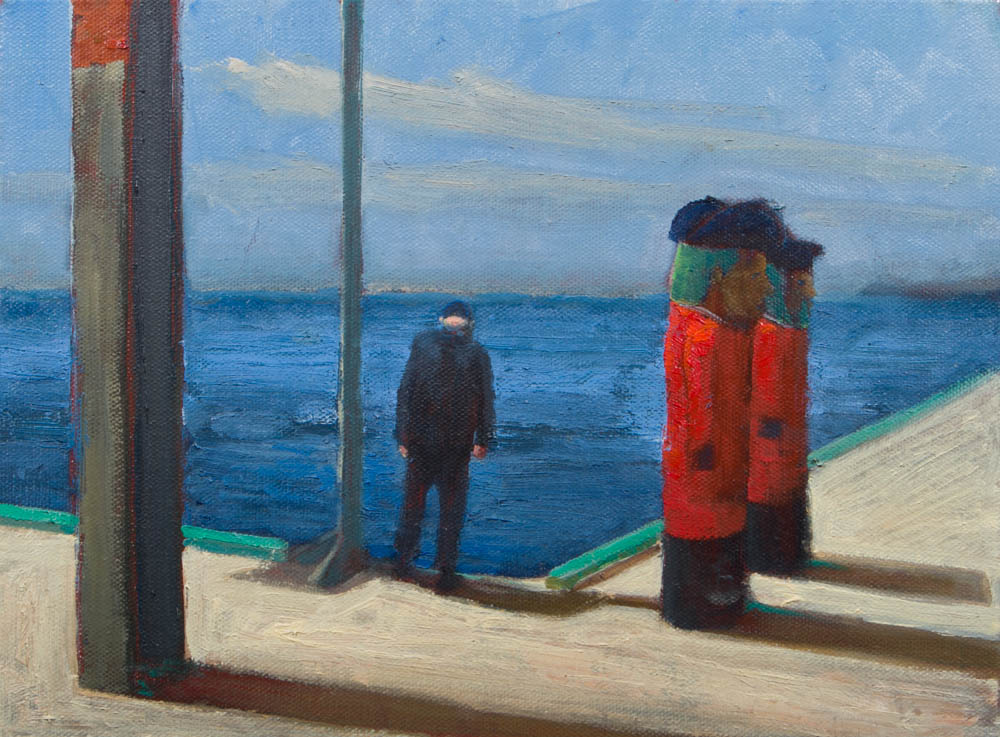


2017 – ‘A Strange Dance‘ No Vacancy Gallery, Melbourne
Artist Statement – (click for dropdown)
Manifold’s oil paintings depict the lone figure ambling through life – in alleyways in Melbourne landscapes, dwarfed by skyscrapers and highway overpasses, quiet places like bathrooms, and the countryside to which he has returned. A dark, saturated palette details hard geometrical surroundings, bathed in the soft liminal glow of dusk and the night-time sky. Sometimes adorning the figure’s torso, a flimsy upturned cardboard box, mimics yet contrasts the impenetrable vast, heavy buildings – yet provides camouflage and protection and paradoxically severing the connection with the outside. This recurring motif’s vulnerable transient interior is accentuated by the sturdy veneers of the surrounding concreted architecture and questions the influence of the modern social delineations, boundaries and interfaces we traverse daily. Manifold’s paintings tread the discourse of unnoticed physical and psychological terrains. City landscapes, constructed by people yet cluttered by ‘anti-spaces’, Manifold’s paintings reflect tensions between states of camouflage and discontinuity in an era of increased communication and alienation. These intimate self-portraits open enquiries regarding the place and positioning of the human condition in this contemporary technological age.


2016 – ‘The Town mouse and The Country Mouse‘ – Maryborough Regional Gallery
Artist Statement – (click for dropdown)
I aimed to start plein air painting the urbanscape of Melbourne, however I found after breaking my ankle in Africa and heading out around Melbourne with crutches and a car that had been written off was impossible. My work has always revolved around personal experiences and the way our surroundings informs identity. Thus, using myself as the protagonist was a natural step, despite not having the #mrboxie guise to hide in. For me, the bathroom is a private and cocoon like place. In fact, when I was young it was the only room in the house that had a lock, creating a quiet sanctuary for me to be without question or interruption. In this series, I am not so much interested in my identity, but more the notion we have chosen to use bathrooms – private – to project a vastly public image into the world through social media. The way we construct ourselves in these selfies that we push out into the world is fascinating! The self consumed nature of it is referenced by the title which highlights the world news – and arguably much more important – events that are happening while we focus inwards. Like #mrboxie, we are connected yet disconnected. My face is deliberately not defined in the paintings. Yet as paintings, which are archivable, they juxtapose against digital selfies that are only valid till the next one is constructed, my paintings are a monument to now.
The work tackles identity, communication and alienation in a self-promotional era. The majority of the paintings being painted in Public bathrooms in front of the mirrors with the urinals, or as the laconic title “Pissers” is a tip of the hat to my tendency to take the piss – both out of others yet mainly myself – something which identifies distinctly as Australian and nods to my upbringing on a rural farm in Victoria. These works are serious, and seriously taking the piss. This lean towards taking the piss is adhered to with the strange pose, or anti-pose, or hiding behind the oversized tablet phone to take the photo – which then through repetition turns into a pose itself and a distinct theme which in turn is a distinct way to stand out. The very act of taking photos of the paintings gives a strange cross of reality – Suddenly you find yourself a part of the image, looking through the screen at ‘yourself’ looking at the screen back at you. Mimicry, taking the piss, in the ‘Pissers’.


2015 – C O N T A I N E D” Rubicon Ari, Melbourne
Artist Statement – (click for dropdown)
The small figures in boxes explore what it means to be alone. For my family, the Australian landscape was both a lonely, foreboding place and the possibility of a longed-for future. My ancestors arrived as early white settlers, and the eldest son, aged nineteen, set out west from Geelong with only his horse.
The boxed figures continue this investigation and exploration into place, isolation, home and communication. They search for connection and attempt to locate themselves within the landscape and the built environment. Their square, cornered forms allow them to echo the shapes of the city: buildings, windows, rooms and screens.
These figures are self-isolating, yet at the same time connected to the wider world through electronic communication. At times, a small, dim glow can be seen emanating from the bottom of the box, suggesting a screen, a device, or a private signal of contact. This points to a newer form of loneliness: we have never been so connected, yet we remain capable of feeling profoundly alone.
This condition has changed our sense of time, patience and emotional expectation. The delay of a message, the absence of a reply, or the silence after contact can become charged with anxiety. The works ask the viewer to consider this tension between connection and isolation, movement and stillness, place and displacement.
Continuing from my recent body of work following the box people through the city, this exhibition extends their search for place and belonging. The works pose quiet questions: What is this place? Why are we here? Where do we belong? In doing so, they mirror the viewer’s own attempts to understand the city, the landscape, and their position within it.


2014 – ‘C L O S E’ – Gallerysmith Project Space, Melbourne
Artist Statement – (click for dropdown)
Manifold’s oil paintings depict emotionally charged urban settings. Lone figure(s) amble through these seemingly abandoned concrete environs ranging from highway underpasses and alleyways and all the way up skypscrapers. An upturned cardboard box, mimicking the rectangular geometries of the cityscape that dwarfs him adorns his torso. It is childish and weighty simultaneously – The obscure solidity of the human designed and constructed urban landscape, armoured in discourse, contrasts with the flimsy cardboard box and its’ psychological space. The box character is not built into the pattern of urban repetition, yet mimics its forms – the juxtaposition of it’s contained psychological space against the vast weight of concrete and sky surrounding it …. questions of alienation, infiltration of discourse.


